
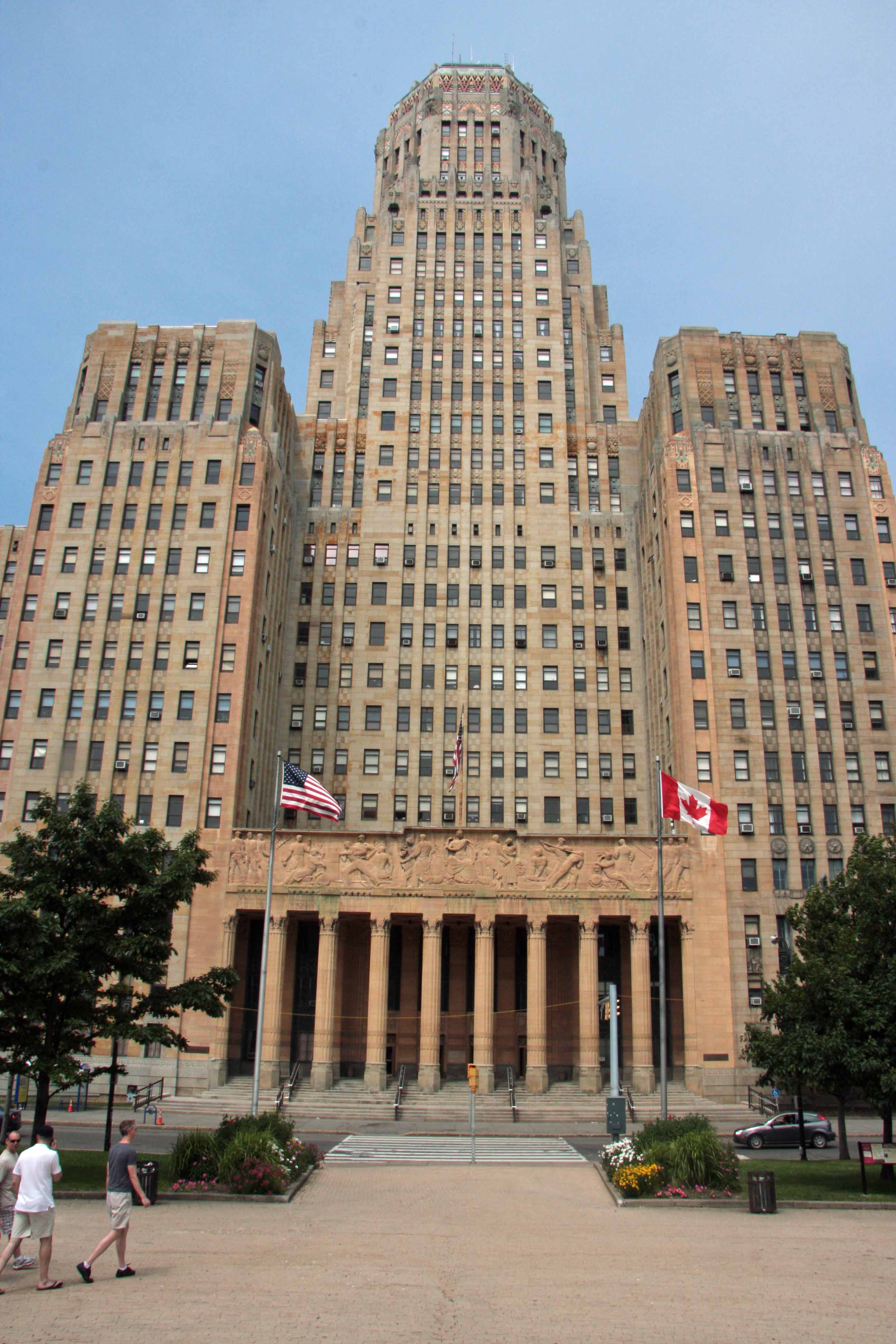
Buffalo City Hall

Buffalo, New York City Hall

As you can tell if you follow my blog, I’m still wondering the streets of Buffalo, New York capturing as many of the historical buildings as I can.
Here’s a brief history of Buffalo’s City Hall:
Buffalo City Hall is the seat for municipal government in the.City of Buffalo, New York Located at 65 Niagara Square, the 32 story Art Deco building was completed in 1931 by Dietel, Wade & Jones.
At 378 ft (115.2 m)height or 398 feet (121.3 m) from the street to the tip of the tower, it is one of the largest and tallest municipal buildings in the United States of America and is also one of the tallest buildings in Western New York. The design was by George Dietel, architect, with the assistance of John J Wade. The friezes were sculpted by Albert Stewart and the sculpture executed by Rene Paul Chambellan. It was listed on the National Register of Historic Places in 1999

This slideshow requires JavaScript.

Quote of the Day:
“No person is your friend who demands your silence, or denies your right to grow.”
-Alice Walker
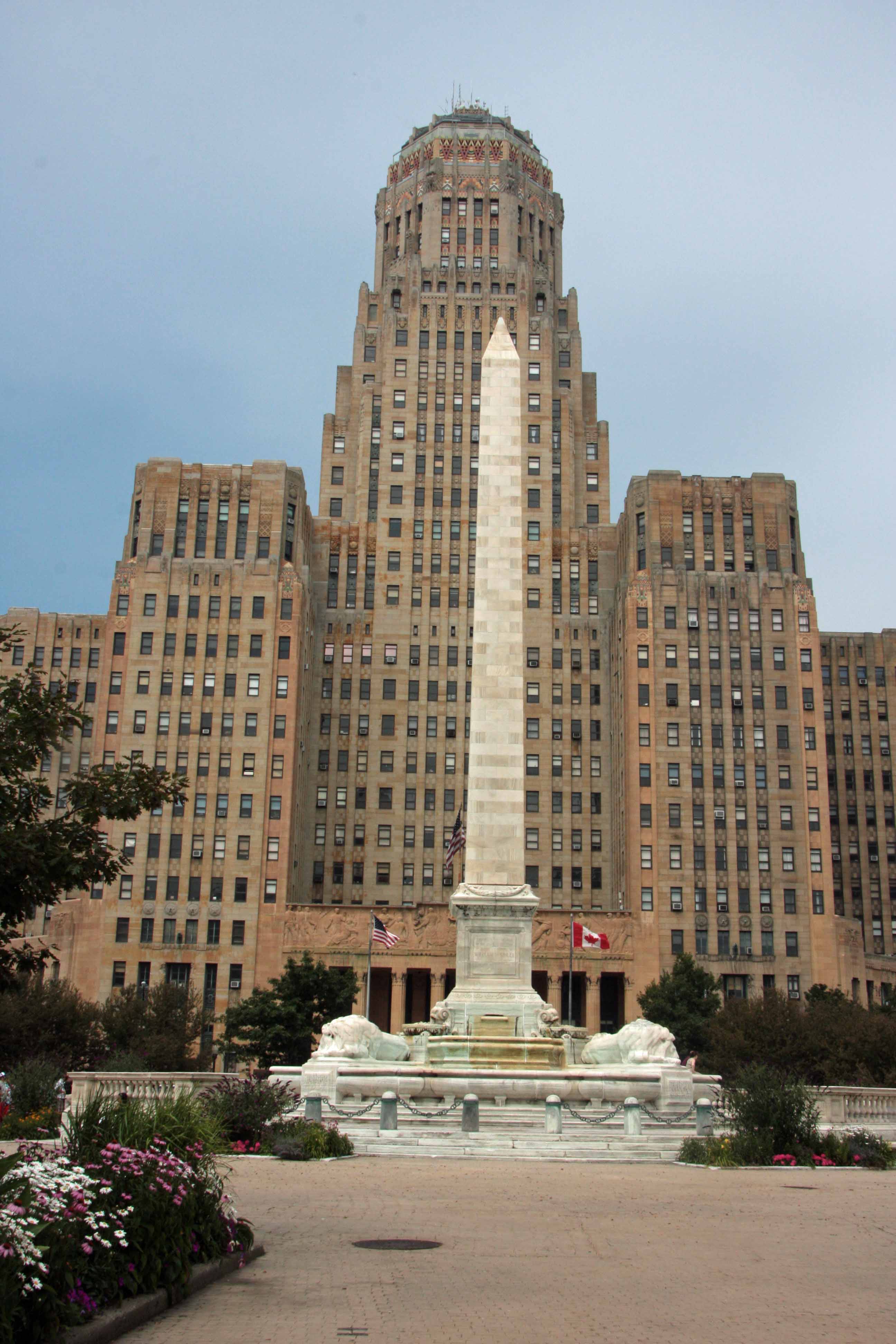
The Mckinley Monument

The Mckinley Monument with Buffalo’s City Hall in the background

This slideshow requires JavaScript.

 
Here’s a few shots of the McKinley Monument with Buffalo’s City Hall in the background. I will post a shot of the City Hall tomorrow. 
 
Brief history:The McKinley Monument is a 96-foot (29 m) tall obelisk in Niagara Square,  Buffalo, New York. Its location in front of Buffalo City Hall defines the center of the city and many of Buffalo’s major roads converge on it.

The monument was commissioned by the State of New York and dedicated September 6, 1907 to the memory of  William McKinley, 25th President of the United States, who was fatally shot while attending the Pan-American Exposition in Buffalo on September 6, 1901.
Architect Daniel H. Burnham, called in to consult on the project, had suggested an obelisk, with fountains at the base and decided where it should be placed. In the end, the monument consists of a Vermont and Italian marble obelisk with surrounding Italian marble lions, each 12 feet (3.7 m) long and weighing 12 tons. It was designed by architects Carrere and Hastings, who had led the design of the Exposition, with animal sculptures by Alexander Phimister Proctor that include sleeping lions, symbols of strength, and turtles, emblematic of eternal life.
Poet Carl Sandburg wrote a poem on the monument, Slants at Buffalo, New York, beginning: “A forefinger of stone, dreamed by a sculptor, points to the sky. / It says: This way! this way!”

Quote of the Day:
“That’s all a man can hope for during his lifetime – to set an example – and when he is dead, to be an inspiration for history.”
William McKinley